
Play Senet Online - An Ancient Egyptian Board Game vs AI
How to Play Senet
Each side has five pieces and races them along a thirty-square path. Get all five off the board first and you win. Along the way you have to deal with blocks, swaps, house 26, the water house, and exact bear-off. When you play against the AI, hints, undo, and replay are always there to help you learn the rhythm of a full game.
Where this version of Senet comes from
Senet is one of the best-known board games from ancient Egypt, and still one of the ancient race games people mention most often today. Archaeologists uncovered boards, pieces, and visual evidence, but not a complete rulebook. So the Senet most people encounter now is a modern reconstruction, pieced together from artifacts, images, and scattered written references.
This site uses a Kendall-style reconstruction: a 3×10 board of thirty squares, two players with five pieces each, and a single shared route to the exit. It is widely used because it stays as close as possible to the surviving evidence while still producing a complete, tense game that holds up over repeated play. That is what lets Senet feel like more than a historical object. It becomes a game you can actually learn and play.
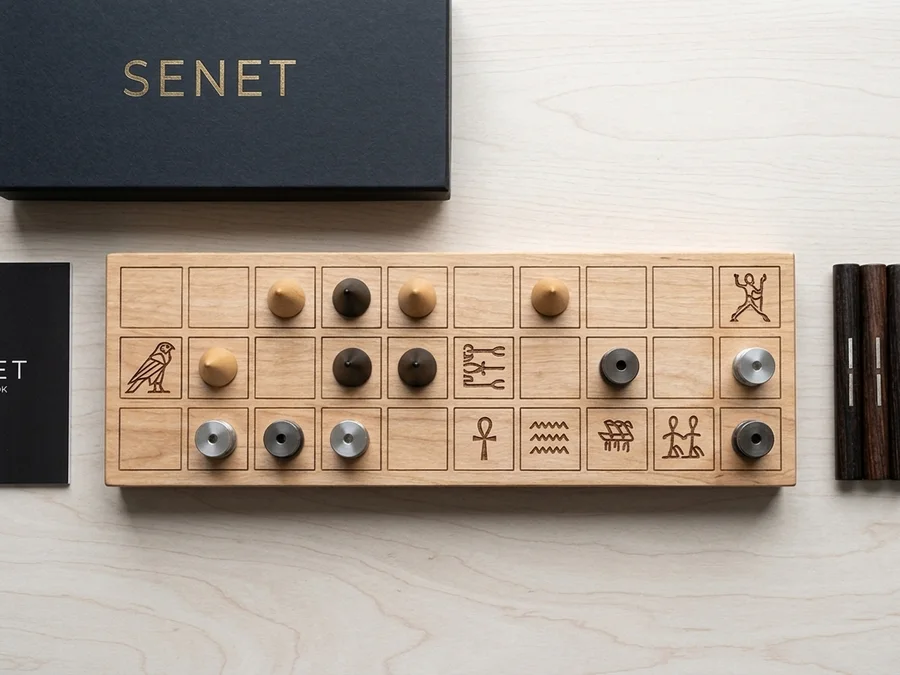
Crowded from the opening
The pieces begin almost shoulder to shoulder, so the very first throw often leads to a swap. Do not focus only on pushing your own pieces forward. If two opposing pieces are linked together, that square is closed: you cannot land there, and you cannot move past it.
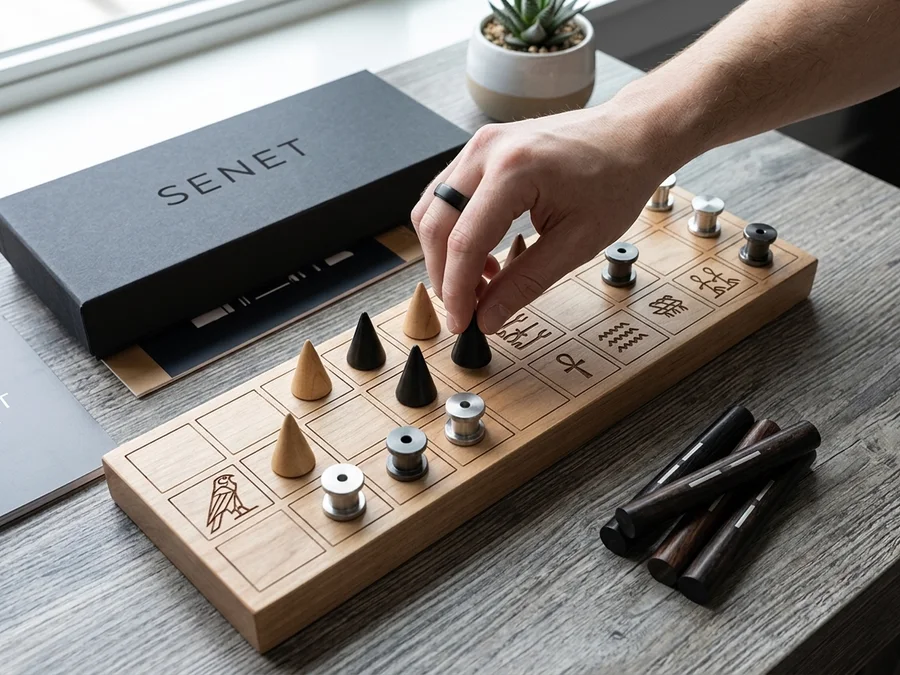
You must stop on 26
A piece has to stop on house 26, the House of Happiness, before it can move into the final stretch. House 27 is the water house: land there and that piece goes back to 15, the House of Rebirth. If one of your own pieces is already on 15, or your opponent is occupying that safe square, then the move cannot be played.
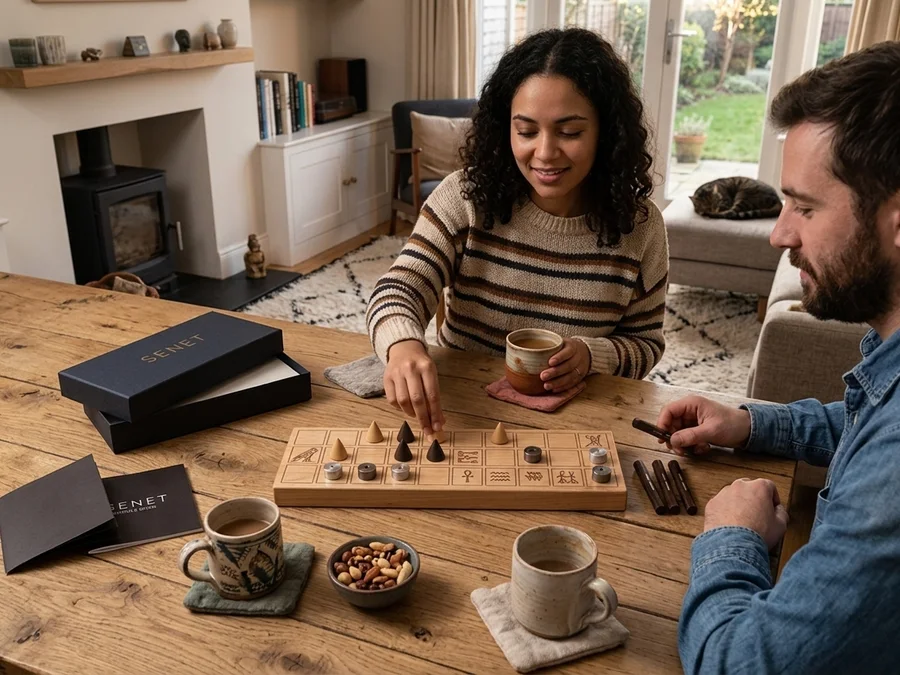
What it feels like to play the AI
No need to wait for anyone or line up a time. Start a game whenever you want, and let the AI help you get familiar with the key squares on the board.
If you get stuck, tap Hint to see what options this throw gives you. If you try a move and do not like the result, use undo and test the alternative.
After the game, replay the full record and look back at the turning points: the move that dropped a piece into the water house, or the swap you could have made a little earlier.
You can play as Black or White. The game record stays in your browser and is never uploaded anywhere.
3×1030 squares, folding path
5pieces per side
1–5from four throwing sticks
Bear offget all five home to win
Common questions
Which Senet rules does this site use?
No complete rulebook survives from ancient Egypt, so every playable Senet today is a reconstruction. This site follows a Kendall-style version: a folding 3×10 track, five pieces each, and four throwing sticks that score 1 to 5. Other versions handle extra throws and safe squares differently, so trust the highlighted moves here.
How do the four throwing sticks score?
Count the flat sides facing up: that gives you 1 to 4. If all four land blank side up, it counts as 5, so you never throw a zero. A 1, 4, or 5 earns another throw once you have made your move.
Why won't some of my pieces move after a throw?
Only the highlighted pieces can use this throw. A piece usually stays put because two enemy pieces in a row block its path, your own piece already sits on the landing square, or the move would skip house 26. If nothing lights up, the turn passes to your opponent.
What happens if I land on house 27?
House 27 is water, and it sends the piece back to house 15. If 15 is already occupied, that move isn't allowed at all. Near the end of the track, waiting on 26 is often smarter than racing ahead and falling in.
Is swapping places the same as capturing?
Not quite. When you land on a lone enemy piece, the two pieces trade squares. Your opponent gets pushed back but stays on the board. Pieces resting on 15 or 26 can't be swapped, and neither can two or more enemy pieces standing together.
How strong is the AI, and which level do hints use?
You can switch between multiple AI levels in the side panel. Start at the gentlest one while you learn walls and the water house, then step up. Hints follow the level you picked rather than quietly using the strongest search, and the AI thinks in the background so the board stays responsive.
How can I use hints, undo, and replay without just copying moves?
After each throw, pick a piece yourself and decide what it's for: a swap, stepping around a wall, or waiting for 26. Then open the hint and compare. If a move goes wrong, undo and try a different piece with the same throw. Once the game ends, replay it to find the move that dropped a piece into the water.
Can I play White, and who throws first?
Black always throws first. Against the AI you can take either color; choose White and the AI opens the game. In two-player mode on one screen there's no side to pick, you simply take turns throwing.
Do I need an account or an app, and is my game saved?
No account and nothing to install. Open the page on a phone or computer and start playing. The game is kept in this browser on this device, so you can usually close the tab and pick up later. Clearing the site's data wipes it.
Should I play a friend on one screen or in an online room?
If you're sitting together, use one screen and take turns. It works offline and keeps undo and replay. If your friend is somewhere else, create an online room and send the link. The room throws the sticks for both of you, so you see the same result, and there are no hints or undo.