
Ancient Egypt left boards, pieces, and visual evidence, but not a complete rulebook. This site uses a Kendall-family reconstruction, so both players, the AI, and online rooms all follow the same legal moves. Start with the two figures below. The first shows the route. The second marks 15, 26, and 27. Once those are clear, a first game is much less likely to feel like guesswork.
Start in 30 seconds
You do not have to memorize this page before you sit down. Hold onto these five steps, then learn the rest while you play. One game is usually enough to feel the rhythm:
- Black always throws first. If you sit White against the AI, the AI takes the opening throw.
- Each turn, throw four sticks for 1 to 4. All blank counts as 5. Then tap a lit piece of yours. Lit means that piece can legally go.
- The opening already alternates pieces on 1 to 10. Landing on a single enemy swaps places. Two or more enemies in a row form a wall. You cannot land there, and you cannot pass through it.
- You have to stop on house 26, the House of Happiness, before the last squares. House 27 is water. Land there and the piece goes back to 15, the House of Rebirth.
- The first player to get all five pieces off on exact counts wins. If the throw is too large, that piece cannot be forced off the board.
For game one, do not get greedy. Watch three things: whether this throw runs into a wall, whether it would skip 26, and whether 15 is open if water sends you back. Keep those three in view and you are already playing with a plan.
How to read the board
Beginners usually do not lose track of the count. They lose track of the middle row, because it turns around. Read the board in three strips: the top row runs left to right, the middle row folds back right to left, and the bottom row runs left to right into the last houses.
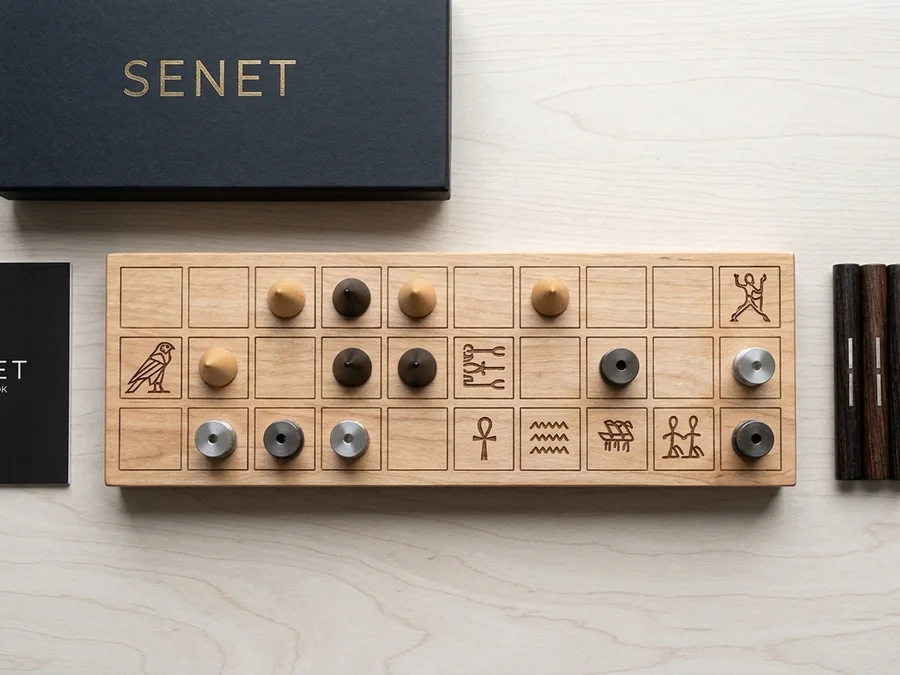
Top row: 1 to 10 already alternate, so the first throw often asks you to swap or stop in front of a wall.
Middle row: this strip runs right to left. A lot of first games go wrong here, because people keep reading it the other way.
Bottom row: once you turn onto this row, house 26, water at 27, and exact bear-off start to matter.
House 15: a safe house, and the square a piece returns to after water.
House 26: until a piece has stopped here, it cannot enter the last squares.
Water at 27: not a shortcut. Land here and the piece goes back to 15, so waiting on 26 is often better than rushing.
Once the route and these three houses are in your head, the rest of the page stops feeling like homework. Houses 15 and 26 are safe. House 27 sends a piece back to 15. The last step off the board still has to be exact: not one square too many, and not one short.
How a turn works
A turn is really two steps: throw, then tap a piece that can use that number. The board lights the legal options, so you do not have to calculate every path first. If nothing lights up, the turn passes.
Your own pieces do not capture each other and cannot stack on one square. Once pieces are out, you can spend the throw on any legal piece on the board. A 1, 4, or 5, followed by a legal move, lets you throw again.
Swaps, blocks, and safe houses
The tense moments are usually one square away from swapping someone off. If your piece lands on a single enemy, the two swap places. Houses 15 and 26 are the exception: you cannot swap a piece sitting there.
Two or more enemy pieces in a row make a wall. You cannot land there, and you cannot move through it. A lot of first games chase every swap they see. Learning that a wall of two is closed ground is usually the more useful habit.
When you throw again
A throw of 1, 4, or 5, followed by a legal move, lets you throw again. That is the main way a turn stretches. Ordinary progress is one move; a favorable throw lets you make another decision right away.
A swap or a fall into water does not, by itself, give you another throw. The extra throw still needs a legal move. If nothing can go, the turn ends immediately.
How you win
The first player to get all five pieces off on exact counts wins. Swaps do not score extra. Plenty of people spend the first game chasing swaps. The real race is getting five pieces home safely, and doing it first.
In an online room both players may resign or offer a draw. Against the AI, or on one device, you may resign or simply start a new game. If both sides agree, the site records a draw.
What changes by mode
All three modes use the same reconstructed rules. The difference is who you play and which tools you get. The home page against AI offers hints, undo, and move-by-move replay. Pass-and-play has undo and replay, but it does not hint for either side. Online rooms sync moves and throws, allow resign or a draw, and do not support one-sided undo.
If you have just finished this page, the best next step is not another article. Open play vs AI and play a game. Watch a wall close the path, see why 26 cannot be skipped, and notice whether 15 is open when water sends a piece back. That is when these rules start to become feel. Once you can finish a game, Senet strategy will stick much faster.
Common questions
Why is all blank a 5, not a pass?
This reconstruction counts four blank sticks as 5. A throw is never 0. The turn passes only when the number has no legal move, not because the sticks came up blank.
Can a piece on 15 or 26 be swapped?
No. Those houses are safe. A single enemy on any other square can be swapped. Two or more in a row form a wall that nobody can swap off.
Why do I have to stop on house 26 first?
That is the reconstruction used here. Until a piece has stopped on the House of Happiness, it cannot enter 27 to 30. If the throw would skip 26, that piece cannot move this turn. Move another piece, or pass.
Is this the original ancient rulebook?
No. Egypt left no complete Senet rulebook. This site uses one Kendall-family reconstruction, the kind used in museums and classrooms. Other modern versions may differ on extra turns, safe squares, and the sticks. Trust the highlights on this board.
Does Black always start?
Every mode begins with Black throwing first. Against the AI you may sit Black or White. If you sit White, the AI throws first.
Who throws the sticks in an online room?
The room throws the number. Both players see the same 1 to 5. A browser cannot pick the result or throw again on its own.